
Business analysts develop requirements for systems, which architects can design to support key processes in the company’s business model. It follows that understanding a company’s business model is very helpful in both these disciplines.
Business models
A business model is just a standardized view of the elements that make your business tick. The standardized view is based on the business model canvas.
The business model canvas
The business model canvas [Wikipedia] explains the elements of any business model:
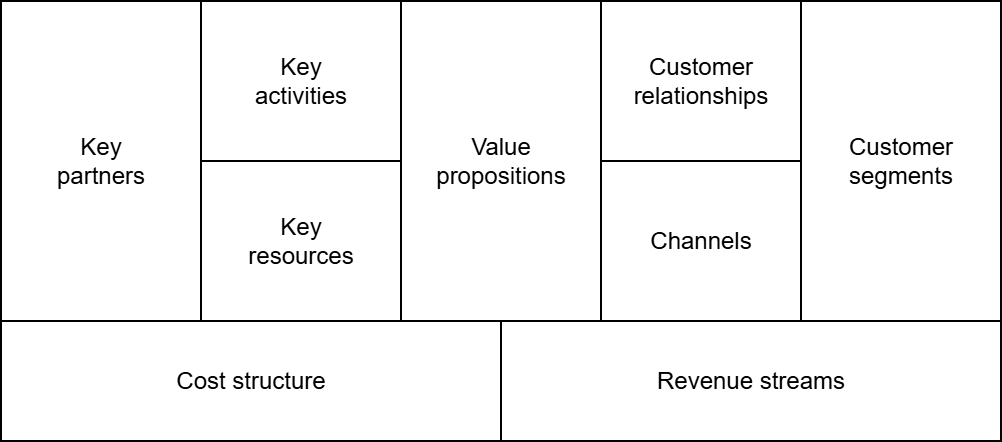
Value propositions are the products and services offered to the market. They are intended to provide value to the customer, making the business a key partner in the customer’s business model. Products and services must keep providing more value than they cost to avoid customers moving to competitors.
Customer relationships are essential for holding on to customers. If the business’s position is weakened, customers will start leaving.
Channels enable customers to order products and services. Some customers may prefer one channel over another, so most businesses provide several channels.
Customer segments are a helpful concept for grouping customers who have similar preferences regarding products, services, and channels. Managing customer relationships should also be tailored to each customer segment.
Revenue streams exist for every combination of products, services, channels, and customer segments.
Cost structure is the grouping of costs that best match key elements of the business model, including the costs associated with each revenue stream.
Key partners are suppliers of raw materials, products, and services needed for maintaining revenue streams and managing the business, which makes it a customer in a segment in each key partner’s business model.
Key activities are all activities involved in maintaining the revenue streams and managing the business. Key activities are often grouped into manageable processes and can also be linked to a capability map.
Key resources are people, machinery, infrastructure, facilities, financial capital, and IT systems.
Since all business models consist of these elements, the business model canvas is a helpful reference in business analysis and architecture work. I always bring a printout to meetings, have it open on my laptop, or draw it on the whiteboard at the beginning of workshops.
Uncovering a company’s business model
In this day and age, the fastest way to uncover a company’s business model is by studying its website. For obvious reasons, companies do their best to convey their value propositions and channels at the front and center of their website.
Web searches for references to the company and other similar businesses can give insights into the company’s customer relationships.
Financial statements tell a lot about revenue streams and cost structures. Some costs will clearly be related to owned assets like buildings or fleets of vehicles and ships. Many companies publish their financial statements on their website, and if they don’t, their financial statements can often be looked up on government-run public archives.
Within the company, interviewing subject matter experts can reveal more details about the business model. Sometimes, if experts’ availability is limited, documents on the intranet may be an alternative. Unfortunately, such content is often too outdated or incomplete to serve as a reliable source.